Economic developers need an AI agenda that connects the work inside our organizations with the businesses and workers we serve and the economic changes our communities face. Making the office more efficient addresses only part of that responsibility.
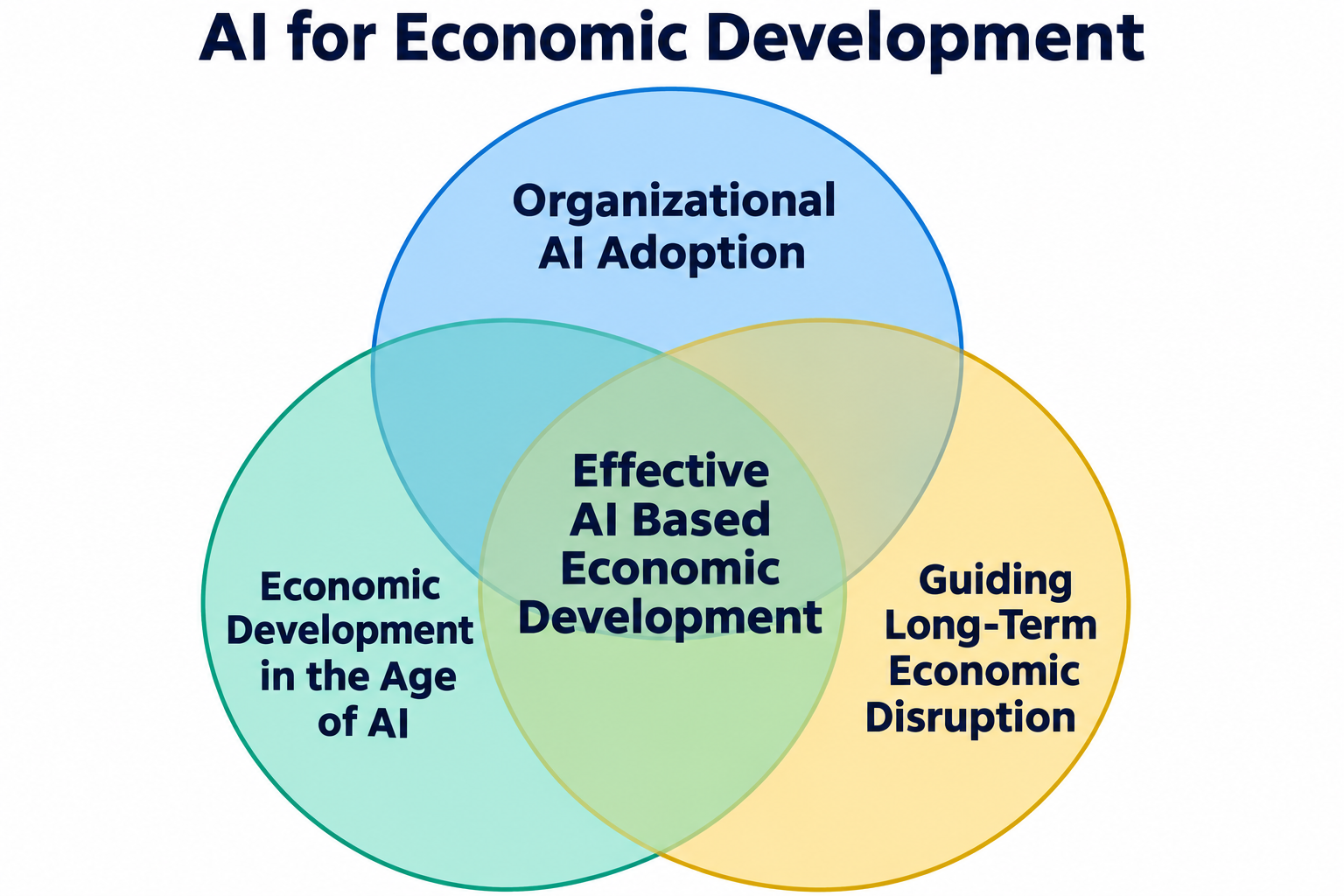
I organize that responsibility into three connected areas: organizational AI adoption, effective economic development in the age of AI, and guiding communities through long-term economic disruption. An economic development organization (EDO) needs to address all three, with priorities shaped by its community.
How should our organization use AI? What should we do to help our local economy participate in its opportunities? How should we prepare for changes that extend beyond any individual project or program? We need to work across all three because decisions made in one affect what becomes possible in the others.
Build the organization's ability to use AI well
The first responsibility begins inside the economic development organization. We need to understand where AI can improve the work, what our staff need to use it effectively, and who remains responsible for the results.
An EDO might test AI assistance in preparing a first draft of a business briefing, organizing public research, or turning approved meeting notes into follow-up tasks. Each use needs to be evaluated against the actual work. A briefing produced more quickly is useful only if the facts are right, the sources support the argument, and staff can explain the recommendation to the people relying on it.
Research gives us a reason to test these possibilities without assuming the results will transfer automatically. In the November 2023 version of Generative AI at Work, Erik Brynjolfsson, Danielle Li, and Lindsey Raymond studied the introduction of an AI assistant among 5,179 customer-support agents. They reported a 14 percent average increase in issues resolved per hour, with larger gains among novice and less-skilled workers and minimal effects among experienced, highly skilled workers. That is evidence from a particular customer-support setting, not a forecast of what an economic development organization will gain. It points us toward a useful question about which tasks and which staff might benefit, followed by a test in our own setting. [1]
This is management work as much as technology work. Staff need time to learn, permission to identify failures, and a clear understanding of where the tool belongs in the workflow. Leadership needs to decide what information may enter a system, what requires human review, and which actions an AI system may take. A tool that drafts a message and a system that sends it create different responsibilities.
The National Institute of Standards and Technology's voluntary AI Risk Management Framework 1.0 organizes risk management around governing, mapping, measuring, and managing, with governance running across the other functions. Its core includes clear responsibilities, training, oversight, monitoring, and attention to risks from outside providers. Those are useful management disciplines for an EDO adapting AI to its mission. [2]
Start with a bounded workflow and decide in advance what improvement would justify keeping it. Measure the time saved alongside the checking time, corrections, service quality, and effects on the people doing the work. For an organization that handles sensitive business information, protecting that information belongs in the design of the pilot. It should never become an issue that someone discovers after the tool is already in use.
Build the local economy's ability to participate
The second responsibility is the economic development work itself. It includes data centers and their infrastructure requirements, but it also includes workforce development, small-business capability, entrepreneurship, business attraction and retention, and the capacity of communities to participate in change.
These are different lines of work, and we need to resist letting the most visible investment become the entire agenda. A community can be weighing a large infrastructure proposal while its existing businesses need help deciding whether an AI tool is useful, its entrepreneurs need access to customers, and its workers need training that connects to real opportunities.
For a data-center proposal, the immediate development question is what the community will receive, what infrastructure and public obligations the project requires, and which institutions can verify and enforce the commitments. Article 02, AI's Data Center Boom Has a Geography Problem, develops that project-specific assessment, including where benefits and costs appear and who carries them.
For small businesses, adoption assistance should begin with the business problem. An owner who needs to reduce the time spent preparing estimates needs help testing a workflow, assessing its accuracy, and understanding its cost. A general introduction to AI may open the conversation, but the development value depends on what the business can do afterward.
The Organisation for Economic Co-operation and Development's (OECD) 2025 report Generative AI and the SME Workforce draws on a late-2024 survey of more than 5,000 small and medium-sized enterprises across seven countries. Among businesses not using generative AI, reported barriers included lack of fit with the work, concerns about information entered into models, and insufficient employee skills. Among users, 65 percent reported improved employee performance, while 26 percent reported increased revenue. These are businesses' reported experiences, not causal estimates, and the survey did not include the United States. They support taking implementation and skills seriously without promising a particular return to a local firm. [3]
Workforce development needs the same connection to actual work. Economic developers can bring employers, workers, community colleges, and workforce partners together to identify changing tasks and develop training around them. We should ask whether people can use what they learn, whether it improves their prospects, and who has difficulty reaching the training in the first place. Attendance is an activity measure; the outcome we care about is what people become able to do.
Companies developing AI technology and companies using AI to build a new product or service may need different kinds of support. I would start by asking founders where they are getting stuck, connecting them with relevant technical expertise and early customers, and assessing whether local capital and support networks match the businesses being built. A startup event can help people meet, but we still need to know whether those relationships help a venture reach a customer, improve a product, or grow.
That work connects to attraction, retention, and expansion. Alongside evaluating emerging firms and corporate divisions that could fit the local economy, we need to understand how existing employers are changing. A business-retention conversation should ask where AI is affecting tasks, purchasing, investment, and staffing, and what would help that business and its workers adapt. Recruitment priorities should follow evidence of local capabilities and needs.
Community development belongs inside this agenda. Libraries, neighborhood organizations, local government, and other trusted institutions can be partners in understanding barriers to participation and designing accessible support. The questions include who has reliable access to tools and training, whose priorities shape the programs, and whether residents can influence decisions that affect their neighborhoods.
An EDO can work through partners, identifying the organizations already providing useful services and helping close gaps that otherwise fall between institutions.
Prepare for changes larger than the current project
The third responsibility is helping communities prepare for wider economic change. It asks what happens to our development strategy as AI changes tasks, business models, infrastructure demands, and the distribution of economic opportunity over time.
The International Labour Organization's (ILO) 2025 occupational-exposure index estimates that one in four workers worldwide is in an occupation with some exposure to generative AI. Exposure describes the potential for technology to affect tasks; it does not mean one in four workers will lose a job. The ILO argues that job transformation is the more likely overall effect because most occupations continue to contain tasks requiring human input. [4]
That distinction matters for local leadership. An estimate of occupational exposure can help us decide where to investigate, but it cannot tell us what an employer has implemented, which positions are changing, or what a particular worker will experience. We need to connect broader research to conversations and evidence from our own economy.
The OECD's 2024 Job Creation and Local Economic Development report identifies different patterns of exposure to generative AI across regional labor markets, with metropolitan regions and regions concentrating industries such as finance, information and communication technology, and education particularly exposed. The report distinguishes this pattern from earlier waves of automation and calls for responses suited to local conditions. Its exposure estimates describe potential change, not observed regional job losses caused by generative AI. [5]
Which local occupations and business services deserve closer monitoring? Are employers changing entry-level hiring or outsourcing? Are productivity improvements supporting expansion, reducing labor demand, or doing both in different firms? Where could changes in employment and business income affect neighborhood spending and the local revenue base?
We also need to ask where business ownership and income will accumulate, whether local firms can reach customers independently or become more dependent on a small number of providers, and what those changes would mean for the community's ability to retain value.
The same longer view belongs in infrastructure and environmental planning. The assessment of an individual data-center proposal should connect to discussions about regional power capacity, water, land, and the allocation of long-term obligations. Those questions require utilities, public bodies, and affected communities, with the EDO contributing economic analysis and convening within its actual authority.
Geopolitical and supply-chain questions belong on the monitoring agenda as well. If changes in technology access, trade policy, or the availability of a critical provider affect local firms, what would they need to adjust? That is a scenario to investigate with businesses, rather than a claim that an EDO can predict or control international technology competition.
We can prepare by naming the conditions that would change our priorities, choosing indicators with our partners, and revisiting them on a regular schedule. A decline in a specific employer's entry-level hiring, for example, could trigger a conversation with that employer and its training partners. It would be a signal to investigate, not proof that AI caused the decline.
Connect the three areas to a decision
An EDO testing an internal AI workflow can develop practical questions for its small-business assistance, while recognizing that the firms it serves have different constraints. Conversations with those firms can reveal changes that belong in workforce planning. Longer-term planning can then change which capabilities the EDO needs to build internally.
If local employers report that routine entry-level tasks are changing, the EDO could work with training partners to investigate the tasks and redesign a pilot program. It could use AI internally to organize public information, with staff verifying the analysis, while monitoring whether the pilot helps people enter or advance in work. Internal capability, practical development, and longer-term adaptation would be connected through one concrete problem.
For your next leadership discussion, put all three areas on one page and record what your organization is doing, what it has learned, and what remains unanswered. Identify the most consequential gap and choose the next action your organization can support with its partners. Name who owns it, what you expect to learn, and when you will review the evidence. You need a decision you can act on, with a way to tell whether the work deserves to continue.
If we want our communities to participate in the AI economy, we have to connect what our organizations are learning with the capabilities our businesses, workers, and residents need to build. That is how an AI agenda becomes economic development work.
Sources and scope
The three-area framework and proposed EDO actions are the author's organizing approach and recommendations. The research below supports specific claims; it does not validate the framework or establish the effectiveness of the proposed local programs. Source pages and summaries were checked November 6, 2026. The full underlying studies were not reviewed for this framing draft.
- Brynjolfsson, E., Li, D., and Raymond, L. (2023, revised November). Generative AI at Work. NBER Working Paper 31161. The figures cited use the working-paper abstract on NBER's page, not a later journal version. DOI: 10.3386/w31161.
- National Institute of Standards and Technology (2023). AI Risk Management Framework 1.0, Core. Voluntary guidance. The page states that a revised framework is in progress; this article refers specifically to version 1.0.
- OECD (2025). Generative AI and the SME Workforce: New Survey Evidence, executive summary. Survey countries: Austria, Canada, Germany, Ireland, Japan, Korea, and the United Kingdom. DOI: 10.1787/2d08b99d-en.
- Gmyrek, P., et al. (2025). Generative AI and Jobs: A Refined Global Index of Occupational Exposure. ILO Working Paper 140. Publication-page summary and abstract. DOI: 10.54394/HETP0387.
- OECD (2024). Job Creation and Local Economic Development 2024: The Geography of Generative AI. Publication-page executive summary. DOI: 10.1787/83325127-en.