When it comes to artificial intelligence and economic productivity, we have to understand that adoption and effective adoption are two different things. It costs almost nothing to open a ChatGPT account or sign up for one of the general-use large language models, and in many cases it costs nothing at all, but the skill to use those tools effectively in a business or a job still requires real investment, investment in organizational infrastructure, in integrating the technology into how the work actually gets done, and in the hands-on skill of working with AI.
At this point, individuals still have to learn both the general skills of using AI and the specific skills that apply to the economic work they are trying to do, because a tool you can access but cannot direct well delivers only a fraction of what it is capable of. Access to these tools is free, while the skill to use them is not, and that gap explains more about the current state of AI and the economy than most analysis acknowledges.
Innovation is only half of disruption
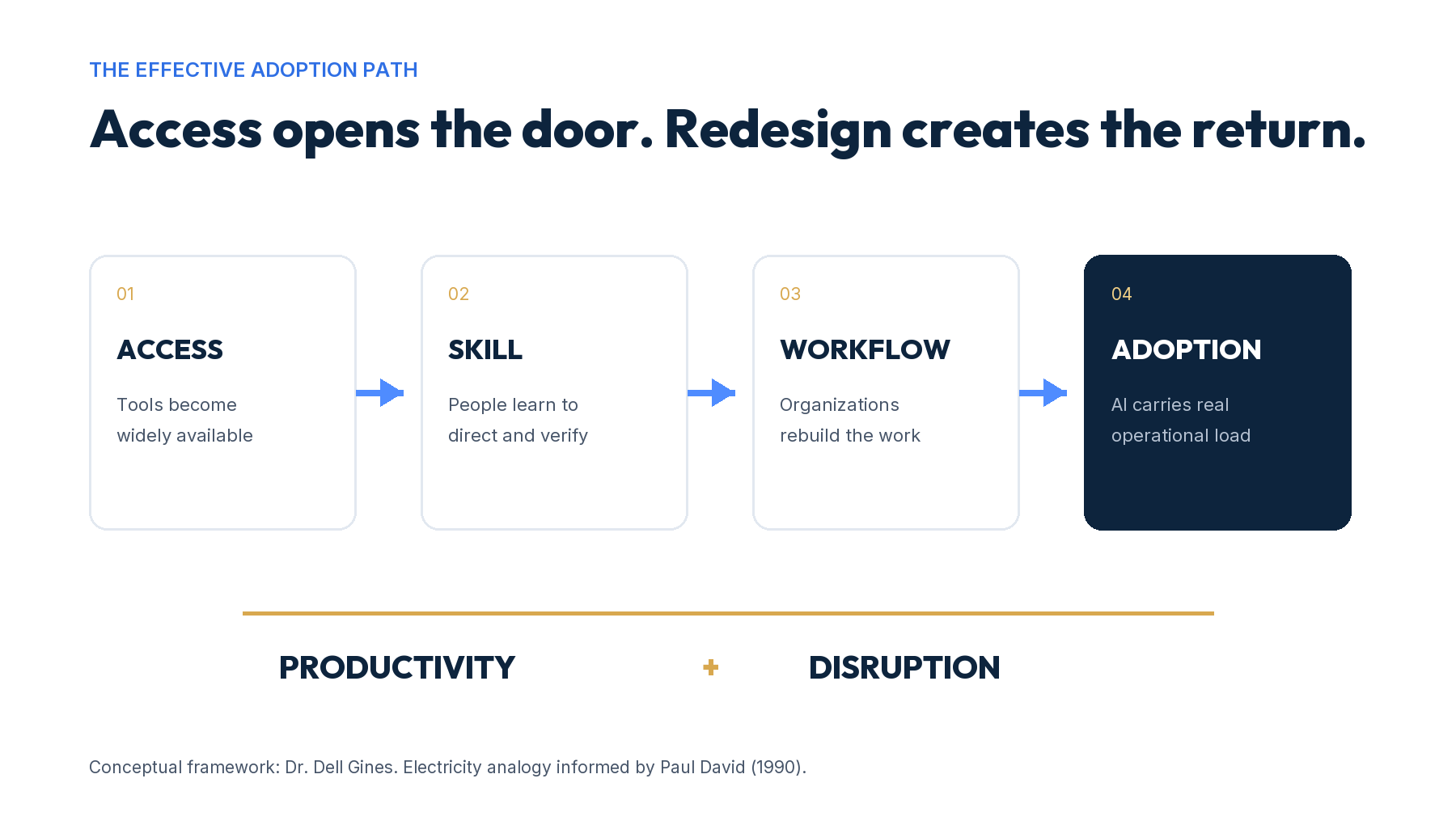
I've argued before that two forces drive AI's disruption of the labor market and the broader economy, the pace at which these tools innovate and the pace at which people and organizations can absorb them and put them to effective use, in entrepreneurship and in the labor market alike. Those two forces don't move independently, because the pace of innovation is largely irrelevant if the pace of adoption cannot absorb what is being built, which means a breakthrough that nobody can use effectively changes very little, no matter how powerful it is. The adoption driving that disruption is effective adoption, the ability to use these tools at the depth where productivity happens, and simply having access to the tools is only the first step toward it.
Economic historian Paul David made this point more than three decades ago in his 1990 paper “The Dynamo and the Computer,” published in the American Economic Review. When electric dynamos first arrived, factory owners simply ripped out the steam engine and dropped the dynamo in its place, keeping the same layout, and productivity barely moved, because the gains only came once factories put a smaller motor on each machine and redesigned the entire floor around that flexibility. According to David's research, U.S. productivity growth did not take off until the 1920s, roughly four decades after electricity was commercialized, which means the technology was never the constraint, the ability to use it effectively was.
The productivity paradox
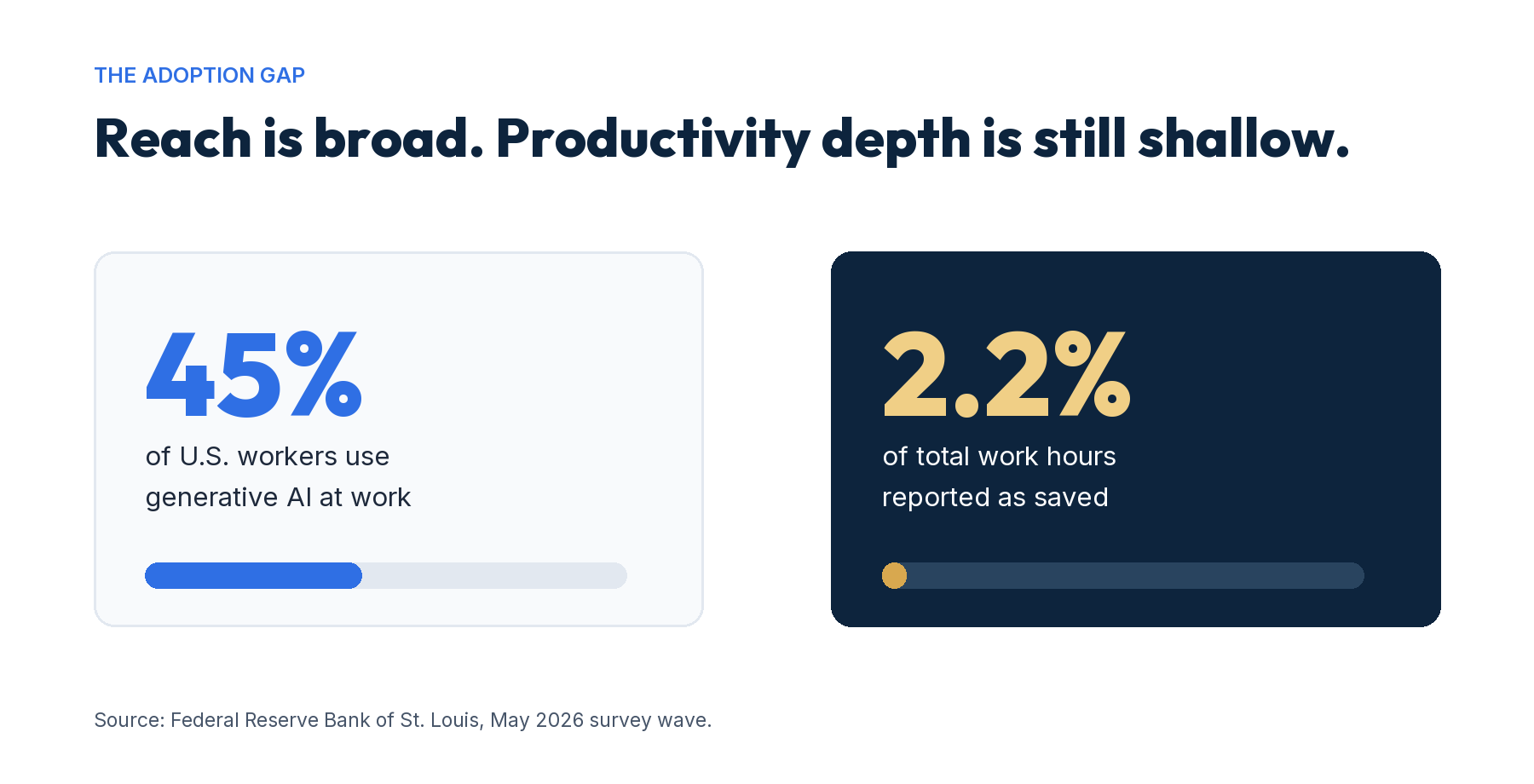
Generative AI has become a near-ubiquitous technology faster than any tool before it. According to OpenAI, ChatGPT alone grew from 400 million weekly users in February 2025 to 900 million a year later, and the company's own figures show that only about 50 million of those users pay for a subscription, roughly one in twenty, which tells you just how low the cost of access has fallen. In the United States, the Federal Reserve Bank of St. Louis reports that 45 percent of workers used generative AI for their jobs as of May 2026, up from 33 percent in August 2024, according to its Real-Time Population Survey.
If nearly half the workforce is using a technology that can draft, analyze, code, and summarize, you would expect to see it clearly in the productivity numbers, and that is where the story gets murky. The Bureau of Labor Statistics shows labor productivity growing at an annualized 2.1 percent since the end of 2019, but economists still debate how much of that growth belongs to AI, and the gains workers report fall far short of what the reach of these tools would suggest, because the same St. Louis Fed survey finds that generative AI saves just 2.2 percent of total work hours.
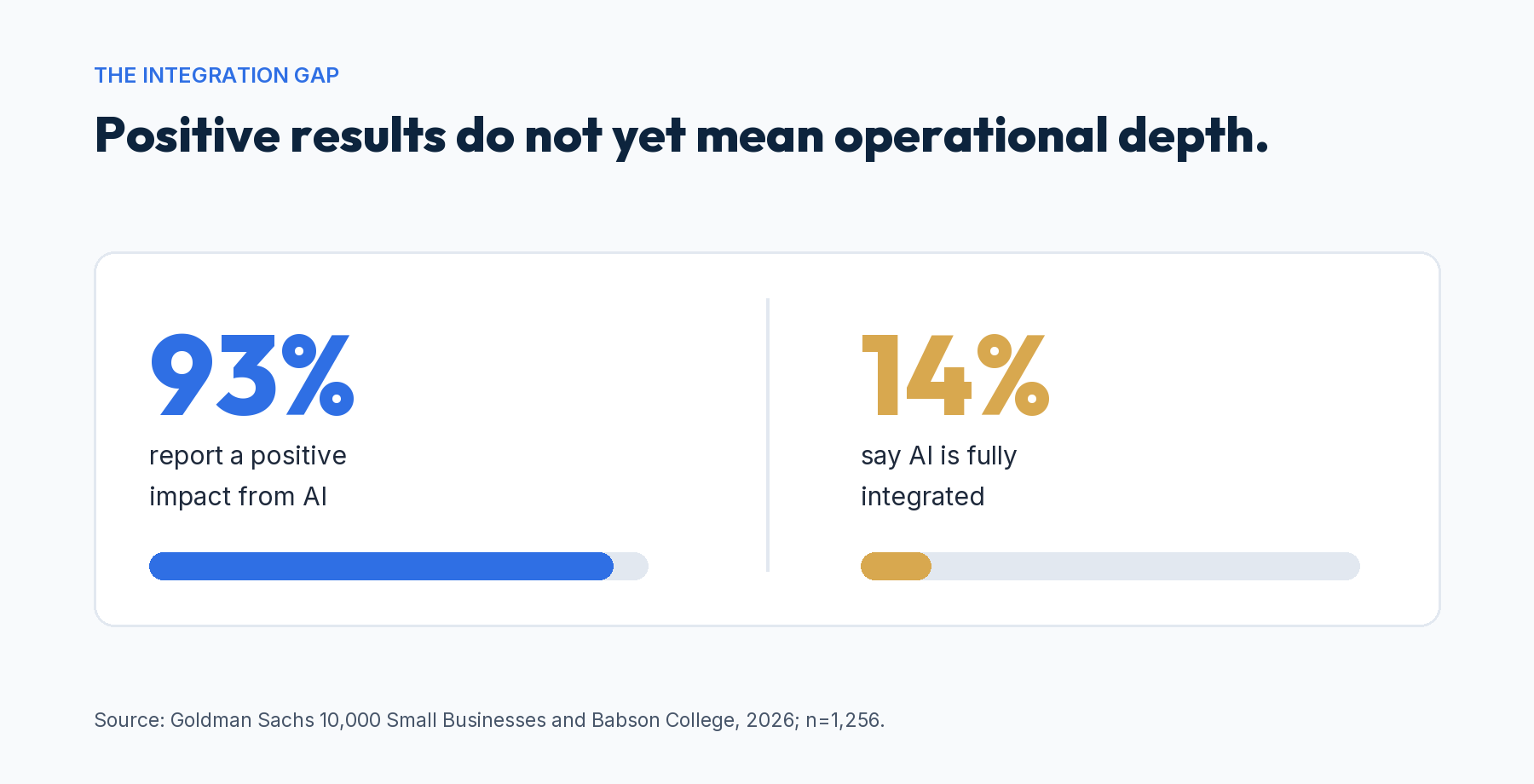
The same pattern shows up among entrepreneurs. A 2026 Goldman Sachs 10,000 Small Businesses survey conducted with Babson College found that 93 percent of small business owners using AI report a positive impact, yet only 14 percent say it is fully integrated into their core operations, and the U.S. Census Bureau's Business Trends and Outlook Survey finds that just 19.8 percent of businesses were using AI in any business function as of May 2026.
So while it is reasonable to infer that artificial intelligence has contributed to the productivity gains we have seen, the wave of labor force disruption and explosive economic growth that so many have predicted has not arrived, at least not at a scale that matches how widely these tools are now being used. When a technology reaches nearly half of the workforce and close to a billion people around the world, and the economy still has not felt its full force, we have to ask why.
How people actually use AI
What the data shows about how people use these tools matches what I hear in conversations across the field. A 2025 National Bureau of Economic Research study by OpenAI's economic research team and Harvard economist David Deming, the largest analysis of real ChatGPT use to date, found that three-quarters of conversations involve practical guidance, seeking information, or writing, with writing accounting for 40 percent of work-related messages and about two-thirds of all writing requests asking the tool to edit, summarize, translate, or critique text people already had. Businesses show the same pattern, and a 2026 Census Bureau working paper found that 57 percent of firms using AI apply it in three or fewer business functions, with writing, document analysis, and information search leading how their workers use generative AI on the job.
The sophisticated uses, where AI runs entire workflows on its own, are concentrated somewhere else entirely. According to Anthropic's Economic Index, three-quarters of enterprise use through its programming interface is automated, compared with less than half on its consumer app, which means the delegation that substitutes AI capital for human capital is being built by companies through code, not by the average worker in a chat window.
I saw this gap firsthand when I recently taught a portion of a class for the Ohio Economic Development Association designed for intermediate users of artificial intelligence. As someone who works with these tools at a fairly sophisticated level every day, I assumed the room would be ready for the more advanced ways of creating efficiency, designing projects effectively around AI, building human-in-the-loop models that define where people and AI each carry the work, and setting up standing agentic protocols that move work forward without being prompted each time. My best estimate is that fewer than 10 percent of the participants had used any of those approaches, and these were people who considered themselves intermediate users, already further along than most of their peers.
Those approaches are exactly what drive real economic productivity, because at that level you are substituting artificial intelligence capital for human capital, and that substitution is where both the productivity gains and the labor market disruption ultimately come from.
The real cost of effective adoption
Effective adoption is the reason the explosive productivity growth and labor market disruption this technology suggests have not arrived at the pace so many expected. Most organizations are trying to lay AI on top of systems built for a different way of working, the same mistake factory owners made when they swapped a dynamo in for the steam engine and kept everything else the same.
Electricity did not unlock its productivity until factories were remodeled around it, and AI will follow the same path, with the next wave coming from AI-native firms that build their infrastructure, their education, and their training around these tools from the start. That kind of adoption means developing the skills of a team or an entrepreneur and restructuring the organization itself so it can accommodate entirely new models of work.
The skill has changed
If we want to see accelerated productivity, we have to look at what it actually costs to achieve it, not just at the low cost of getting access to a tool that has the capacity to create it. For decades, becoming a programmer meant investing in education, training, and years of work experience to build a technical skill, and now the tool can write the code itself, which removes that old barrier entirely.
The need for skill remains, because what changes is the skill itself, and someone still has to learn how to direct the tool effectively, how to vet what it produces, and how to validate that the output works, which takes its own investment of time and learning, both in the general skill of working with AI and in the specific knowledge of how it applies to a particular business or job. The labor market has not caught up to that shift, our education and training systems have not caught up to it, and the infrastructure inside most firms has not caught up to it either, which leaves us with a technology whose access is nearly free and whose effective use is not.
When the governor comes off
Those of us who have been predicting significant labor market disruption and a shift in the entrepreneurial landscape have been looking at what these tools can already do and what they will keep doing as innovation continues, and the only real governor on how fast that disruption arrives is the slow pace of effective adoption. That slow pace is a benefit to the economy, because it gives people, firms, and communities time to learn how to work with these tools, which allows the economy to absorb the change rather than be overwhelmed by it.
That governor will not hold indefinitely, because the pressure for return on investment never lets up. As firms retool their infrastructure, as more entrepreneurs build AI-native firms from the ground up, and as more workers get trained or teach themselves the skills to use these tools effectively, the pace of effective adoption will accelerate and release both the productivity and the disruption at the same time.
That leaves us with two questions we have to answer before the wave arrives rather than after it. The first is how we distribute the gains from that productivity so they reach more than the firms and individuals who adopt first, and the second is how we manage the disruption that comes with it, the frictional unemployment as workers move between roles and the churn in the entrepreneurial landscape as the economy shifts from simple adoption to effective adoption.
What this means for economic development
From an economic and community development lens, we can no longer afford to play it safe and conservative the way our field traditionally has. If you want your community positioned for what is coming, you have to be far more aggressive in understanding this technology and how it is actually being used, positioning your companies and your community for effective adoption rather than simple access, working with your workforce development organizations now to plan for how jobs will pivot, and partnering with your entrepreneurship organizations to prepare founders for a landscape where AI-native firms set the pace. Access to these tools is already nearly free, which means the work left for economic developers is lowering the cost of skill.
The communities that get ahead of the curve on effective adoption will suffer far less disruption and capture far more of the productivity that follows. The ones that wait will absorb the disruption and watch the gains go somewhere else.
Sources
All figures checked against primary or official sources as of October 15, 2026.
- David, P. A. (1990). The Dynamo and the Computer: An Historical Perspective on the Modern Productivity Paradox. American Economic Review, Papers and Proceedings, 80(2).
- OpenAI announcement of 900 million weekly ChatGPT users and 50 million subscribers, February 27, 2026, reported by TechCrunch. February 2025 figure via OpenAI statistics roundup.
- Federal Reserve Bank of St. Louis, What Work Does Generative AI Do?, September 2026, and the GenAI Adoption Tracker (Bick, Blandin, and Deming, Real-Time Population Survey), May 2026 wave.
- U.S. Bureau of Labor Statistics, Productivity and Costs, Second Quarter 2026, Revised, September 3, 2026.
- Goldman Sachs 10,000 Small Businesses Voices, Small Businesses Embrace AI but Need Training and Support to Fully Harness It, survey of 1,256 owners by Babson College and David Binder Research, January 27 to February 4, 2026.
- U.S. Census Bureau, AI Use Among Businesses, Business Trends and Outlook Survey data through May 3, 2026.
- U.S. Census Bureau, Center for Economic Studies, The Microstructure of AI Diffusion: Evidence From Firms, Business Functions, and Worker Tasks, Working Paper 26-25, April 2026.
- Chatterji, Cunningham, Deming, et al., “How People Use ChatGPT,” NBER Working Paper, 2025, summarized in OpenAI, How people are using ChatGPT.
- Anthropic, Economic Index and the January 2026 report. Anthropic is the developer of Claude.